I've written poetry and lyrics in the past, but it's been awhile. This past weekend I got a little silly - for a good cause - and reworked the first two minutes of Don McLean's American Pie into a contest entry. I'm hoping to win my registration to ALIA's fifth New Librarians Symposium, NLS5.
At first I wished there had not been a two-minute restriction for audio/visual entries because that's only a quarter of the length of the original song - but by Sunday's end, after singing the same two minutes over and over, then cutting different videos together in iMovie, then messing with transitions and tracks...I was glad it was only two minutes. The lyrics are meant to tell the story of my metamorphosis (it's the conference theme) from girl to undergrad to library student, and make my case for why I should win a conference pass.
Unfortunately, some of my better audio runs had blurry or poorly lit video accompaniment. I considered doing a full track of my voice and laying it on top of the muted video, with a third track of music underneath, but heavens, I'd already been singing and watching myself sing all day! I'm a bit of a shy one when it comes to singing, and this is my first-ever YouTube video. Here's hoping it will be good for my professional development (at least until my husband leaks the bloopers reel). Jody recorded my performances and we stitched together the movies as a team. Here is the result:
If you click on 360p and choose 720p, you can even watch it in HD :) The lyrics are under "show more."
Good luck if you've entered the contest too! And I hope to see you in Perth.
Showing posts with label MLIS. Show all posts
Showing posts with label MLIS. Show all posts
Monday, July 11, 2011

Tuesday, June 28, 2011
It's Official
I received my student ALIA membership card in the mail today!

ALIA stands for Australian Library and Information Association. It's Australia's peak body for libraries and information professionals. Now that I'm a student member I will have access to journals, e-lists, ALIA publications and other benefits. I'm planning to go to the New Librarians Symposium in Perth this September, also.
Hooray for becoming an information professional!

ALIA stands for Australian Library and Information Association. It's Australia's peak body for libraries and information professionals. Now that I'm a student member I will have access to journals, e-lists, ALIA publications and other benefits. I'm planning to go to the New Librarians Symposium in Perth this September, also.
Hooray for becoming an information professional!
Wednesday, June 22, 2011
The Future of eBooks Forum - part one
Today I attended a forum at the State Library of Queensland (SLQ) that was all about ebooks. Librarians and student librarians were tweeting throughout the event, and socialising over morning tea and lunch on the slightly chilly terrace.
Presenters included:
Martin Taylor - founding director of the Digital Publishing Forum for digital publishing in NZ, publisher and managing director at Addenda Publishing.
Kate Eltham - CEO of QLD Writers Centre since 2006, founder of if:book Australia.
Sherman Young - Assoc. Professor and Assoc. Dean of Learning & Teaching in Arts at Macquarie, author of The Book is Dead, Long Live the Book.
John Scott - Burdekin Library Services Manager (via recorded video)
Jacinda Woodhead - associate editor of Overland literary journal, runs blogs Overland and Meanland.
Jennifer Moran - panelist and contributor to Sydney Morning Herald and The Australian.
Ebook lending may be the way forward for libraries, but there are many challenges along the way. Ebook channels are still evolving and the lifecycle of the ebook is not yet stable, so although there is room for error, there is also room for experimentation.
Martin Taylor had a tough job today - speaking from the publishing side. If you're unfamiliar with the cloud over publishing lately, Harper Collins USA has been very unpopular with libraries and librarians since they changed their terms of service to allow only 26 checkouts per ebook before requiring the library to repurchase the title. They say that is the average number of checkouts a paperback can withstand before it needs replacing. Some librarians have responded with an intention to boycott, and others are fighting to increase the arbitrary number of loans.
Taylor expects that ebooks will eventually follow a model not unlike the movie industry, where cost to the user decreases post-release, and the publisher makes more money in the long run than in the opening days of a release. He says public libraries will face new challenges for patrons' time, and that the greatest threat to libraries' digital success will be a bad customer service experience. He adds that terms are needed to manage channel conflict (ie; publishers-authors-libraries-schools), and that libraries will face new competition.
A partnership between publishers and libraries is Taylor's hope for the future. Within this partnership, they would talk directly to authors and publishers, challenge traditions by "opening the door" to a hybrid paid/free model, and help the public understanding of the need to experiment and change. As to the libraries themselves, they should consider and trial several access models, creating options that work at each point in a book's economic lifestyle.
Kate Eltham discussed ebook lending, both in libraries and peer to peer. New consumer models include commercial peer to peer services, which she likens to 18th century private libraries, where chosen members could borrow books. The Lendle (Kindle) and Lend Me (Barnes & Noble) "matchmaking service" style services available to US ebook readers is a step in the right direction, but it's limited by geography and a single-loan model, neither of which helps Australian libraries.
Eltham notes that the library sector is shackled with policies at the moment, but believes that libraries will deal directly with self-published authors in the near future. She thinks the internet can tackle issues of geography, access, and convenience, and that we should think about the book as a service, not as a product.
More tomorrow... if you follow me on Twitter, you can read my feed from today, or other public Twitter feeds by searching for #slqteb
Presenters included:
Martin Taylor - founding director of the Digital Publishing Forum for digital publishing in NZ, publisher and managing director at Addenda Publishing.
Kate Eltham - CEO of QLD Writers Centre since 2006, founder of if:book Australia.
Sherman Young - Assoc. Professor and Assoc. Dean of Learning & Teaching in Arts at Macquarie, author of The Book is Dead, Long Live the Book.
John Scott - Burdekin Library Services Manager (via recorded video)
Jacinda Woodhead - associate editor of Overland literary journal, runs blogs Overland and Meanland.
Jennifer Moran - panelist and contributor to Sydney Morning Herald and The Australian.
Ebook lending may be the way forward for libraries, but there are many challenges along the way. Ebook channels are still evolving and the lifecycle of the ebook is not yet stable, so although there is room for error, there is also room for experimentation.
Martin Taylor had a tough job today - speaking from the publishing side. If you're unfamiliar with the cloud over publishing lately, Harper Collins USA has been very unpopular with libraries and librarians since they changed their terms of service to allow only 26 checkouts per ebook before requiring the library to repurchase the title. They say that is the average number of checkouts a paperback can withstand before it needs replacing. Some librarians have responded with an intention to boycott, and others are fighting to increase the arbitrary number of loans.
Taylor expects that ebooks will eventually follow a model not unlike the movie industry, where cost to the user decreases post-release, and the publisher makes more money in the long run than in the opening days of a release. He says public libraries will face new challenges for patrons' time, and that the greatest threat to libraries' digital success will be a bad customer service experience. He adds that terms are needed to manage channel conflict (ie; publishers-authors-libraries-schools), and that libraries will face new competition.
A partnership between publishers and libraries is Taylor's hope for the future. Within this partnership, they would talk directly to authors and publishers, challenge traditions by "opening the door" to a hybrid paid/free model, and help the public understanding of the need to experiment and change. As to the libraries themselves, they should consider and trial several access models, creating options that work at each point in a book's economic lifestyle.
Kate Eltham discussed ebook lending, both in libraries and peer to peer. New consumer models include commercial peer to peer services, which she likens to 18th century private libraries, where chosen members could borrow books. The Lendle (Kindle) and Lend Me (Barnes & Noble) "matchmaking service" style services available to US ebook readers is a step in the right direction, but it's limited by geography and a single-loan model, neither of which helps Australian libraries.
Eltham notes that the library sector is shackled with policies at the moment, but believes that libraries will deal directly with self-published authors in the near future. She thinks the internet can tackle issues of geography, access, and convenience, and that we should think about the book as a service, not as a product.
More tomorrow... if you follow me on Twitter, you can read my feed from today, or other public Twitter feeds by searching for #slqteb
Tuesday, June 21, 2011
SLQ Labs Tour - part two
Part Two: Storage, Pest Prevention & Environmental Monitoring
The preservation lab staff at SLQ take great care in storing and exhibiting artefacts, but before anything can enter the lab, it goes through quarantine. It is carefully checked for pests that could spread to other items, or do further damage. No harsh chemicals are used. Freezing temperatures and oxygen deprivation are the safest and most reliable methods of controlling pests and fungal growth. Staff check each box afterwards to remove any pests that have surfaced during treatment.
When an item is stored, two considerations are paramount: the packaging, and the environment. The SLQ team makes custom-sized boxes and sleeves to suit the item or document to be stored. An encapsulation machine uses conservation-grade plastic to create sleeves, cut and sealed to size. The encapsulator leaves one corner unsealed to allow for airflow, and a small amount of space at the top that can be cut open. The sleeve can then be reused and resealed with a smaller document inside. The paper and cardboard used is carefully selected to meet conservation guidelines.

Optimal light, temperature relative humidity are also factors in storage and exhibition. The environment around art objects, documents and other artefacts is carefully monitored and controlled.
For more information, see SLQ's website.
The preservation lab staff at SLQ take great care in storing and exhibiting artefacts, but before anything can enter the lab, it goes through quarantine. It is carefully checked for pests that could spread to other items, or do further damage. No harsh chemicals are used. Freezing temperatures and oxygen deprivation are the safest and most reliable methods of controlling pests and fungal growth. Staff check each box afterwards to remove any pests that have surfaced during treatment.
When an item is stored, two considerations are paramount: the packaging, and the environment. The SLQ team makes custom-sized boxes and sleeves to suit the item or document to be stored. An encapsulation machine uses conservation-grade plastic to create sleeves, cut and sealed to size. The encapsulator leaves one corner unsealed to allow for airflow, and a small amount of space at the top that can be cut open. The sleeve can then be reused and resealed with a smaller document inside. The paper and cardboard used is carefully selected to meet conservation guidelines.

For more information, see SLQ's website.
Monday, June 20, 2011
SLQ Labs Tour - part one
Under the better-late-than-never category... library labs tour, May 31st.

Part One: Cleaning, Repair and Digitisation
The State Library of Queensland preservation labs are a study in ordered chaos. Everything is catalogued - twice - with an exhibit reference and artefact number. Team members are responsible for particular artefacts and they keep their stations prepped with tools of the task. Rolled-up maps await repairs and flattening, many of them already drycleaned and ready for the more meticulous restoration processes. Japanese paper is in regular use to "infill" tears and holes, where more similar paper cannot be found. The paper is coloured to match as closely as possible to the original document. If pieces survive, they are kept with the document to ease repair work.

Drycleaning paper is just one of the processes the SLQ's donated maps will undergo, and it's hard on your hands so task-switching is a must. Too much drycleaning can also be bad for the artefact, obscuring or erasing pencil marks. Graphite smudges, though, get special treatment. A Staedtler white eraser is grated, then brushed over the surface of smudged paper with a lightly weighted bundle of lead wrapped in cloth, which cleans without rubbing out intentional pencilled notations. Often these notations are the most interesting part of the map or plan - signatures, notes, measurements, dates. An old-fashioned shaving brush is used to gently sweep away the eraser.

Digitisation is another important part of preservation, and the team at SLQ have recently acquired a large scanner to handle poster-sized maps and other ephemera. It looks rather like a keyboard, with the scanning bed where the piano keys would go. It can scan approximately one large map in 5 minutes, and the resolution is high enough that browsers of the digital archives can plainly see the paper, not just the content. It is intended to provide as much accuracy as possible for those who cannot view the original document. Only true black and white pictures are scanned in B&W - most have colour enough, even if it is present only in the paper used, to warrant colour scanning. The IT department was very surprised at the specifications ordered by the digital archivists!

Our group asked many questions in the little scanning room, and we were very grateful to the enthusiastic and patient staff who answered them. Actually we asked many questions throughout the tour...
More tomorrow, on storage, pest prevention and environmental monitoring.
**Any errors are my own, as this post was written from photos, meagre notes and my memory.

Part One: Cleaning, Repair and Digitisation
The State Library of Queensland preservation labs are a study in ordered chaos. Everything is catalogued - twice - with an exhibit reference and artefact number. Team members are responsible for particular artefacts and they keep their stations prepped with tools of the task. Rolled-up maps await repairs and flattening, many of them already drycleaned and ready for the more meticulous restoration processes. Japanese paper is in regular use to "infill" tears and holes, where more similar paper cannot be found. The paper is coloured to match as closely as possible to the original document. If pieces survive, they are kept with the document to ease repair work.

Drycleaning paper is just one of the processes the SLQ's donated maps will undergo, and it's hard on your hands so task-switching is a must. Too much drycleaning can also be bad for the artefact, obscuring or erasing pencil marks. Graphite smudges, though, get special treatment. A Staedtler white eraser is grated, then brushed over the surface of smudged paper with a lightly weighted bundle of lead wrapped in cloth, which cleans without rubbing out intentional pencilled notations. Often these notations are the most interesting part of the map or plan - signatures, notes, measurements, dates. An old-fashioned shaving brush is used to gently sweep away the eraser.
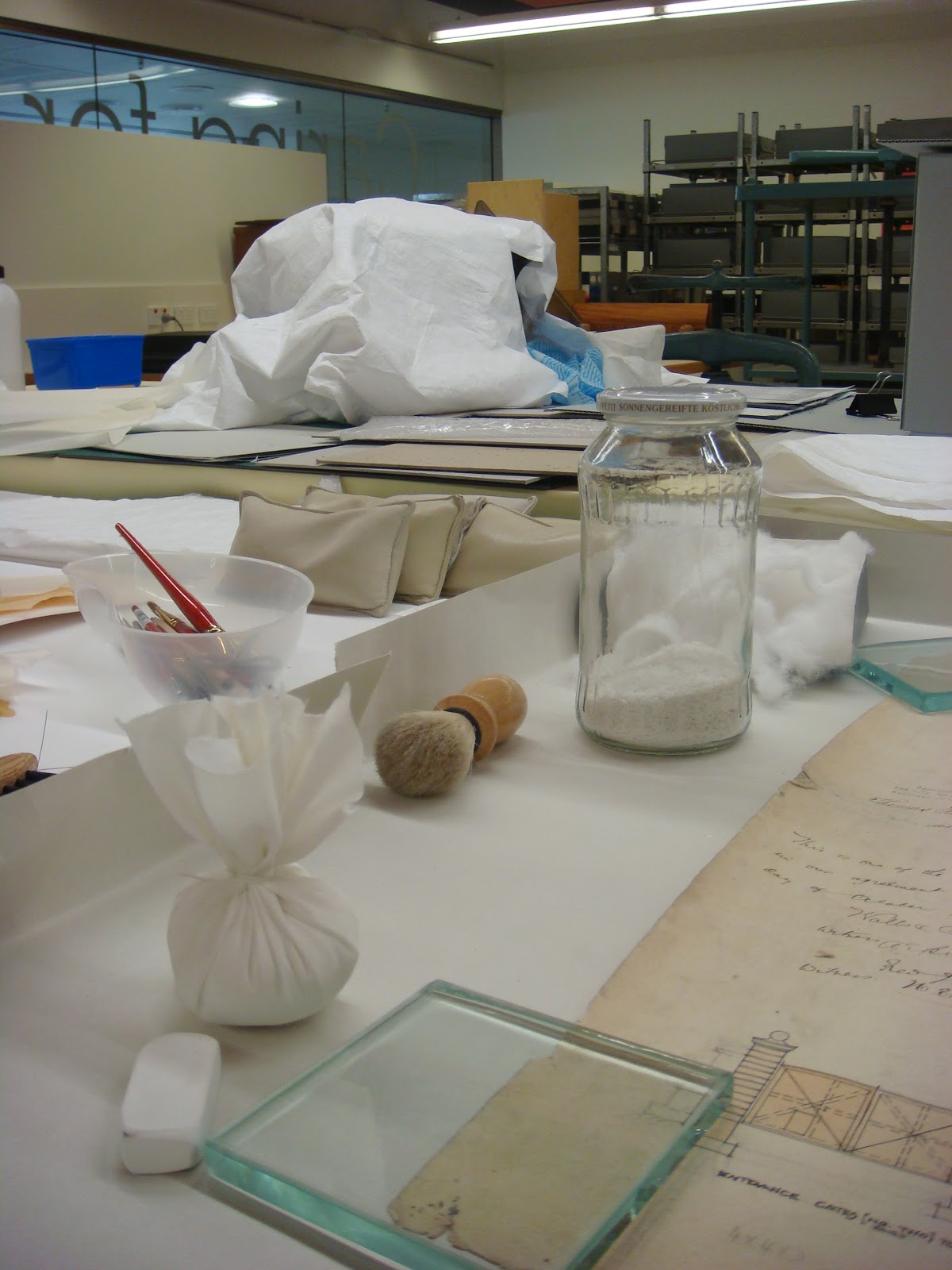
Digitisation is another important part of preservation, and the team at SLQ have recently acquired a large scanner to handle poster-sized maps and other ephemera. It looks rather like a keyboard, with the scanning bed where the piano keys would go. It can scan approximately one large map in 5 minutes, and the resolution is high enough that browsers of the digital archives can plainly see the paper, not just the content. It is intended to provide as much accuracy as possible for those who cannot view the original document. Only true black and white pictures are scanned in B&W - most have colour enough, even if it is present only in the paper used, to warrant colour scanning. The IT department was very surprised at the specifications ordered by the digital archivists!

Our group asked many questions in the little scanning room, and we were very grateful to the enthusiastic and patient staff who answered them. Actually we asked many questions throughout the tour...
More tomorrow, on storage, pest prevention and environmental monitoring.
**Any errors are my own, as this post was written from photos, meagre notes and my memory.
Thursday, June 9, 2011
Wikimedia Workshop
I was chosen as one of two QUT students from IT43 to attend a Wikimedia workshop at the State Library of Queensland on Monday, May 16th. Craig Franklin, QLD representative, and John Vandenberg, Wikimedia president for Australia, taught the session at The Edge.
We began with an overview of 10 Simple Rules and the 5 Pillars of editing, then learned how the Wiki family of sites is interconnected. There's a single sign-on, so once you've registered, you can add content across all the wikis.
During the training session we edited some scanned text. The Wiki software uses OCR (Optical Character Recognition) to read and interpret scanned documents, but it's not perfect. Faded or antiquated fonts are more difficult to process, and human eyes are needed to proofread, with a second volunteer to verify the initial proofread. In these types of content pages, the "original" copy is retained alongside the plain text, for reference and as added value. A historical document or early print edition of a book, for instance, is notable for its format and not just its content.
What do you think of WIkipedia? Do you use it or run in fear? Craig and John assured us that Wikipedia's collective knowledge is growing and has become more reliable than when it was first started up. Some high-profile pages, for example Katy Perry's entry, are locked so that only certain accounts can make changes - this has cut down on malicious edits. The upload and naming policies aren't exactly strict (in fact, you're encouraged to BE BOLD!) and it seems more people are becoming part of this amazing worldwide knowledge network.
What astounded me was the woman in the workshop who had no background knowledge or Wikipedia at all. It's certainly not new, so I assumed anyone who'd spent any time online would have come across it and known its basic principles. But when we were editing pages of the scanned book, she noticed an earlier edit and asked, "Who is that?" and I just shrugged and said, "Some guy." She was astounded that he wasn't a professor, or a writer, or a vetted expert in the field. She just didn't understand, until that moment, that Wikipedia was literally the encyclopaedia that anyone can edit. I'm glad she came to the workshop and hope she is able to use her new skills in her work!
It was neat to edit the scanned book and learn more about OCR. I wish the workshop had been more advanced because I might end up teaching a session on wiki editing myself, along with Katya, the other participant from QUT.
So, Wikipedia, Wikimedia, etc... bane or blessing of your existence?
We began with an overview of 10 Simple Rules and the 5 Pillars of editing, then learned how the Wiki family of sites is interconnected. There's a single sign-on, so once you've registered, you can add content across all the wikis.
During the training session we edited some scanned text. The Wiki software uses OCR (Optical Character Recognition) to read and interpret scanned documents, but it's not perfect. Faded or antiquated fonts are more difficult to process, and human eyes are needed to proofread, with a second volunteer to verify the initial proofread. In these types of content pages, the "original" copy is retained alongside the plain text, for reference and as added value. A historical document or early print edition of a book, for instance, is notable for its format and not just its content.
What do you think of WIkipedia? Do you use it or run in fear? Craig and John assured us that Wikipedia's collective knowledge is growing and has become more reliable than when it was first started up. Some high-profile pages, for example Katy Perry's entry, are locked so that only certain accounts can make changes - this has cut down on malicious edits. The upload and naming policies aren't exactly strict (in fact, you're encouraged to BE BOLD!) and it seems more people are becoming part of this amazing worldwide knowledge network.
What astounded me was the woman in the workshop who had no background knowledge or Wikipedia at all. It's certainly not new, so I assumed anyone who'd spent any time online would have come across it and known its basic principles. But when we were editing pages of the scanned book, she noticed an earlier edit and asked, "Who is that?" and I just shrugged and said, "Some guy." She was astounded that he wasn't a professor, or a writer, or a vetted expert in the field. She just didn't understand, until that moment, that Wikipedia was literally the encyclopaedia that anyone can edit. I'm glad she came to the workshop and hope she is able to use her new skills in her work!
It was neat to edit the scanned book and learn more about OCR. I wish the workshop had been more advanced because I might end up teaching a session on wiki editing myself, along with Katya, the other participant from QUT.
So, Wikipedia, Wikimedia, etc... bane or blessing of your existence?
Wednesday, June 1, 2011
The Perils of Poor Word Choice

I'll start off #blogjune on a lighthearted note. There may be no stupid questions, but there certainly are poorly worded ones. I can imagine that I'll be asked some strange and wonderful questions when I become a librarian, but hopefully no one will run screaming from the reference section at gunpoint.
I've been doing a lot of thinking about what kind of librarian I'd like to be. When I spoke to @katiedatwork back in January about the MLIS program, she said I could figure it out as I go. Thank goodness! The more I learn the more there is to learn. Over the past three months I've discovered professions I didn't know existed, and am now able to give friends less vague answers to the question: "What do you learn in your library degree anyway?"
I am so excited about the possibilities! I've been to lots of library tours and workshops to explore the profession I'll soon find myself in. Yes, I'm a bit of a nerd. And yes, the tours only made me more excited, and more intrigued by how many industries need librarians and information professionals. Unlike the career paths of my grandparents, mine won't follow a straight line.
Libraries Interact is hosting a challenge to blog every day in June! We'll see how I go. You can follow the 60 bloggers here - http://www.netvibes.com/katejf - if you understand how. I'll try to make sense of it tomorrow!
Comic from http://buttersafe.com/2011/05/31/advice/
Tuesday, April 19, 2011
Power
Power is one of those English words that I wish had a wider vocabulary, like 'love' in Greek. Dictionary definitions run the gamut from political authority to energy or exerted force to strength and ability. For a word to be used in so many contexts is frustrating to new English speakers and bothersome for writers (and librarians). If you take a moment, I'm sure you'll think of a variety of ways we use the word power. Here's some I came up with:
- Political - "in power"
- Rights movements - "empowered"
- Car ads - "powerful engine"
- Sports - "power play"
- Faith - "power of the Holy Spirit"
- Business - "power words, power suits"
It struck me that many of these uses are worthless unless there is belief behind the power. Stay with me, I do have a point - or at least some thoughts. See, if politicians can't gather people to believe in his/her ability to lead, they won't come into power. And if you believe a cause isn't worthy of a fight, how is it empowering to stand up for your rights?
Read more »
Monday, April 4, 2011
Down the wire
I've been reading and thinking about communication lately. I had an assignment to speak to an information professional, for instance, and I learned that intuition and communication were prized tools in management. It got me thinking about how I will apply what I'm learning in a corporate or academic environment, and what I can do to improve my own communication skills. For starters, I'm trying to keep up this blog with an average of 4 posts a month. That's the goal, anyway. Secondly, I joined Twitter, but to keep my freakout quotient down, so far I'm just following uni cohorts and library-related accounts.
I still get excited when there's a new e-mail in my box, like I used to when I got snail mail addressed to me. If you know anyone who's deployed, or is constantly relocated, correspondence is gold. I kept shoeboxes of letters sent from my penpals for years while my family was overseas. Now I just re-read my e-mails when I'm lonely or feeling out of touch, and it's not quite the same thing as seeing your friend's handwriting.
 I rarely get anything in the mailbox now but bills, real estate ads and pizza coupons*, but I use my cell/mobile phone throughout the day. I'm sure I use it more for text messages, social media, and e-mail than actual phone calls. Sometimes I'm even surprised when it rings!
How about you? How do you like to communicate? Over a cup of tea, on the phone, with Skype? Do you think our communication skills have suffered under the influence of social media?
Should we be worried, or is this just a natural progression, and our skills are simply becoming more diverse? Is the immediacy of digital communication a bonus or just another way of tying us to our devices?
On a more contentious note - are your family members part of your online experience, or do you try to keep family and friends in separate spheres? How about the older generations in your family? Some of mine have e-mail and nothing else - I'm quite proud of them for learning that, but I still send paper cards for special occasions because an e-card just doesn't seem to cut it. Others don't even have a computer, and I admit I could be better at sending them letters to keep them in the loop.
Today on facebook I came across a survey that asked which 3 out of 100 websites I visited daily, and mine were facebook, Twitter and Gmail. It struck me that all three are related to communication... I suppose that shows I value keeping up with people. But how personal is personal communication when it's mostly text and intangible attachments?
*Edit - My family and close friends keep in touch via e-mail, Skype and facebook for the most part, but they also send me birthday and holiday cards and the occasional care package - often with chocolate.
I still get excited when there's a new e-mail in my box, like I used to when I got snail mail addressed to me. If you know anyone who's deployed, or is constantly relocated, correspondence is gold. I kept shoeboxes of letters sent from my penpals for years while my family was overseas. Now I just re-read my e-mails when I'm lonely or feeling out of touch, and it's not quite the same thing as seeing your friend's handwriting.
 I rarely get anything in the mailbox now but bills, real estate ads and pizza coupons*, but I use my cell/mobile phone throughout the day. I'm sure I use it more for text messages, social media, and e-mail than actual phone calls. Sometimes I'm even surprised when it rings!
How about you? How do you like to communicate? Over a cup of tea, on the phone, with Skype? Do you think our communication skills have suffered under the influence of social media?
Should we be worried, or is this just a natural progression, and our skills are simply becoming more diverse? Is the immediacy of digital communication a bonus or just another way of tying us to our devices?
On a more contentious note - are your family members part of your online experience, or do you try to keep family and friends in separate spheres? How about the older generations in your family? Some of mine have e-mail and nothing else - I'm quite proud of them for learning that, but I still send paper cards for special occasions because an e-card just doesn't seem to cut it. Others don't even have a computer, and I admit I could be better at sending them letters to keep them in the loop.
Today on facebook I came across a survey that asked which 3 out of 100 websites I visited daily, and mine were facebook, Twitter and Gmail. It struck me that all three are related to communication... I suppose that shows I value keeping up with people. But how personal is personal communication when it's mostly text and intangible attachments?
*Edit - My family and close friends keep in touch via e-mail, Skype and facebook for the most part, but they also send me birthday and holiday cards and the occasional care package - often with chocolate.
Monday, March 28, 2011
Excuses, excuses
I know, I know... it's been a whole month. I'm sorry. I've been very busy, I promise. And with what's happening in Japan and Libya lately, it seemed almost superficial to just post another book review or recipe, but I couldn't really think of what to say that hasn't already been said by someone with a greater depth of understanding than me.
-And then another week passed while I went on vacation-
Four weeks ago I began a thrilling, terrifying adventure - grad school. Yes, I have re-entered higher education, and am on my way to becoming a librarian! Not the bun-wearing, shushing kind either - but aside from that I don't know what kind of librarian I would like to be. As technology creates more formats to hold information, librarians' jobs change and their roles expand. I don't think libraries will die out anytime soon, they'll just be different from how they're portrayed in movies like The Music Man.
"What do you want to take out?"
"The librarian."
God, I love that line. Robert Preston is gold. And Shirley Jones...I can never pick whether I love her as Marian, Laurey, or Julie best.
Expect to see more library, book and DRM (digital rights management) related posts in the future. It will take me approximately 18 months of full-time study to earn my MLIS (Masters in Library and Information Science), and that's as a follow-up to my English B.A. There's far more to library studies than shelving, cataloguing and microfiche!
Librarian 2.0 - Twitter account, red glasses, nose stud, Kindle and all.

-And then another week passed while I went on vacation-
Four weeks ago I began a thrilling, terrifying adventure - grad school. Yes, I have re-entered higher education, and am on my way to becoming a librarian! Not the bun-wearing, shushing kind either - but aside from that I don't know what kind of librarian I would like to be. As technology creates more formats to hold information, librarians' jobs change and their roles expand. I don't think libraries will die out anytime soon, they'll just be different from how they're portrayed in movies like The Music Man.
"What do you want to take out?"
"The librarian."
God, I love that line. Robert Preston is gold. And Shirley Jones...I can never pick whether I love her as Marian, Laurey, or Julie best.
Expect to see more library, book and DRM (digital rights management) related posts in the future. It will take me approximately 18 months of full-time study to earn my MLIS (Masters in Library and Information Science), and that's as a follow-up to my English B.A. There's far more to library studies than shelving, cataloguing and microfiche!
Librarian 2.0 - Twitter account, red glasses, nose stud, Kindle and all.

Subscribe to:
Posts (Atom)