I've written poetry and lyrics in the past, but it's been awhile. This past weekend I got a little silly - for a good cause - and reworked the first two minutes of Don McLean's American Pie into a contest entry. I'm hoping to win my registration to ALIA's fifth New Librarians Symposium, NLS5.
At first I wished there had not been a two-minute restriction for audio/visual entries because that's only a quarter of the length of the original song - but by Sunday's end, after singing the same two minutes over and over, then cutting different videos together in iMovie, then messing with transitions and tracks...I was glad it was only two minutes. The lyrics are meant to tell the story of my metamorphosis (it's the conference theme) from girl to undergrad to library student, and make my case for why I should win a conference pass.
Unfortunately, some of my better audio runs had blurry or poorly lit video accompaniment. I considered doing a full track of my voice and laying it on top of the muted video, with a third track of music underneath, but heavens, I'd already been singing and watching myself sing all day! I'm a bit of a shy one when it comes to singing, and this is my first-ever YouTube video. Here's hoping it will be good for my professional development (at least until my husband leaks the bloopers reel). Jody recorded my performances and we stitched together the movies as a team. Here is the result:
If you click on 360p and choose 720p, you can even watch it in HD :) The lyrics are under "show more."
Good luck if you've entered the contest too! And I hope to see you in Perth.
Showing posts with label library. Show all posts
Showing posts with label library. Show all posts
Monday, July 11, 2011

Tuesday, June 28, 2011
It's Official
I received my student ALIA membership card in the mail today!

ALIA stands for Australian Library and Information Association. It's Australia's peak body for libraries and information professionals. Now that I'm a student member I will have access to journals, e-lists, ALIA publications and other benefits. I'm planning to go to the New Librarians Symposium in Perth this September, also.
Hooray for becoming an information professional!

ALIA stands for Australian Library and Information Association. It's Australia's peak body for libraries and information professionals. Now that I'm a student member I will have access to journals, e-lists, ALIA publications and other benefits. I'm planning to go to the New Librarians Symposium in Perth this September, also.
Hooray for becoming an information professional!
Tuesday, June 21, 2011
SLQ Labs Tour - part two
Part Two: Storage, Pest Prevention & Environmental Monitoring
The preservation lab staff at SLQ take great care in storing and exhibiting artefacts, but before anything can enter the lab, it goes through quarantine. It is carefully checked for pests that could spread to other items, or do further damage. No harsh chemicals are used. Freezing temperatures and oxygen deprivation are the safest and most reliable methods of controlling pests and fungal growth. Staff check each box afterwards to remove any pests that have surfaced during treatment.
When an item is stored, two considerations are paramount: the packaging, and the environment. The SLQ team makes custom-sized boxes and sleeves to suit the item or document to be stored. An encapsulation machine uses conservation-grade plastic to create sleeves, cut and sealed to size. The encapsulator leaves one corner unsealed to allow for airflow, and a small amount of space at the top that can be cut open. The sleeve can then be reused and resealed with a smaller document inside. The paper and cardboard used is carefully selected to meet conservation guidelines.

Optimal light, temperature relative humidity are also factors in storage and exhibition. The environment around art objects, documents and other artefacts is carefully monitored and controlled.
For more information, see SLQ's website.
The preservation lab staff at SLQ take great care in storing and exhibiting artefacts, but before anything can enter the lab, it goes through quarantine. It is carefully checked for pests that could spread to other items, or do further damage. No harsh chemicals are used. Freezing temperatures and oxygen deprivation are the safest and most reliable methods of controlling pests and fungal growth. Staff check each box afterwards to remove any pests that have surfaced during treatment.
When an item is stored, two considerations are paramount: the packaging, and the environment. The SLQ team makes custom-sized boxes and sleeves to suit the item or document to be stored. An encapsulation machine uses conservation-grade plastic to create sleeves, cut and sealed to size. The encapsulator leaves one corner unsealed to allow for airflow, and a small amount of space at the top that can be cut open. The sleeve can then be reused and resealed with a smaller document inside. The paper and cardboard used is carefully selected to meet conservation guidelines.

For more information, see SLQ's website.
Monday, June 20, 2011
SLQ Labs Tour - part one
Under the better-late-than-never category... library labs tour, May 31st.

Part One: Cleaning, Repair and Digitisation
The State Library of Queensland preservation labs are a study in ordered chaos. Everything is catalogued - twice - with an exhibit reference and artefact number. Team members are responsible for particular artefacts and they keep their stations prepped with tools of the task. Rolled-up maps await repairs and flattening, many of them already drycleaned and ready for the more meticulous restoration processes. Japanese paper is in regular use to "infill" tears and holes, where more similar paper cannot be found. The paper is coloured to match as closely as possible to the original document. If pieces survive, they are kept with the document to ease repair work.

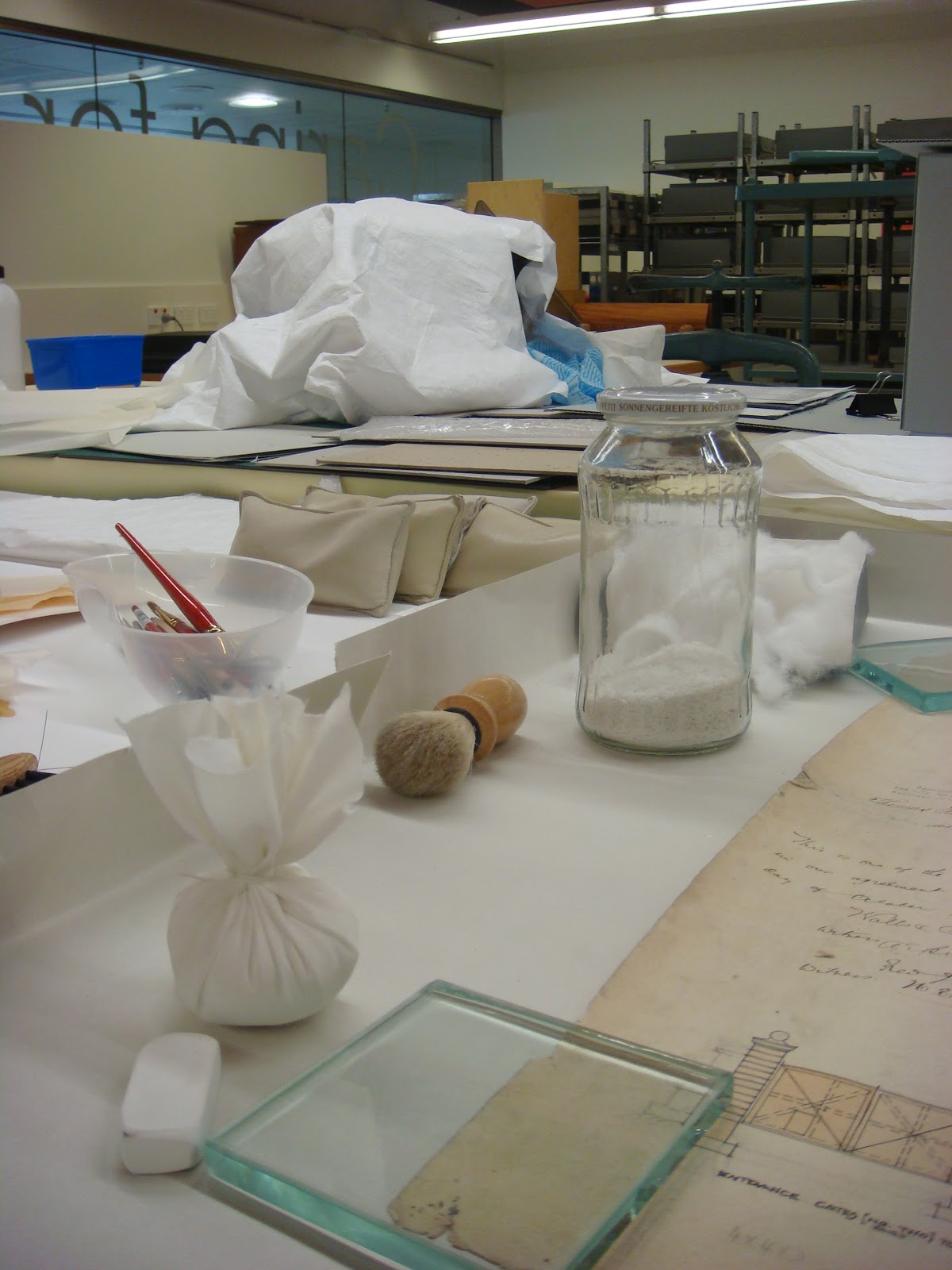
Drycleaning paper is just one of the processes the SLQ's donated maps will undergo, and it's hard on your hands so task-switching is a must. Too much drycleaning can also be bad for the artefact, obscuring or erasing pencil marks. Graphite smudges, though, get special treatment. A Staedtler white eraser is grated, then brushed over the surface of smudged paper with a lightly weighted bundle of lead wrapped in cloth, which cleans without rubbing out intentional pencilled notations. Often these notations are the most interesting part of the map or plan - signatures, notes, measurements, dates. An old-fashioned shaving brush is used to gently sweep away the eraser.

Digitisation is another important part of preservation, and the team at SLQ have recently acquired a large scanner to handle poster-sized maps and other ephemera. It looks rather like a keyboard, with the scanning bed where the piano keys would go. It can scan approximately one large map in 5 minutes, and the resolution is high enough that browsers of the digital archives can plainly see the paper, not just the content. It is intended to provide as much accuracy as possible for those who cannot view the original document. Only true black and white pictures are scanned in B&W - most have colour enough, even if it is present only in the paper used, to warrant colour scanning. The IT department was very surprised at the specifications ordered by the digital archivists!

Our group asked many questions in the little scanning room, and we were very grateful to the enthusiastic and patient staff who answered them. Actually we asked many questions throughout the tour...
More tomorrow, on storage, pest prevention and environmental monitoring.
**Any errors are my own, as this post was written from photos, meagre notes and my memory.

Part One: Cleaning, Repair and Digitisation
The State Library of Queensland preservation labs are a study in ordered chaos. Everything is catalogued - twice - with an exhibit reference and artefact number. Team members are responsible for particular artefacts and they keep their stations prepped with tools of the task. Rolled-up maps await repairs and flattening, many of them already drycleaned and ready for the more meticulous restoration processes. Japanese paper is in regular use to "infill" tears and holes, where more similar paper cannot be found. The paper is coloured to match as closely as possible to the original document. If pieces survive, they are kept with the document to ease repair work.

Drycleaning paper is just one of the processes the SLQ's donated maps will undergo, and it's hard on your hands so task-switching is a must. Too much drycleaning can also be bad for the artefact, obscuring or erasing pencil marks. Graphite smudges, though, get special treatment. A Staedtler white eraser is grated, then brushed over the surface of smudged paper with a lightly weighted bundle of lead wrapped in cloth, which cleans without rubbing out intentional pencilled notations. Often these notations are the most interesting part of the map or plan - signatures, notes, measurements, dates. An old-fashioned shaving brush is used to gently sweep away the eraser.
Digitisation is another important part of preservation, and the team at SLQ have recently acquired a large scanner to handle poster-sized maps and other ephemera. It looks rather like a keyboard, with the scanning bed where the piano keys would go. It can scan approximately one large map in 5 minutes, and the resolution is high enough that browsers of the digital archives can plainly see the paper, not just the content. It is intended to provide as much accuracy as possible for those who cannot view the original document. Only true black and white pictures are scanned in B&W - most have colour enough, even if it is present only in the paper used, to warrant colour scanning. The IT department was very surprised at the specifications ordered by the digital archivists!

Our group asked many questions in the little scanning room, and we were very grateful to the enthusiastic and patient staff who answered them. Actually we asked many questions throughout the tour...
More tomorrow, on storage, pest prevention and environmental monitoring.
**Any errors are my own, as this post was written from photos, meagre notes and my memory.
Thursday, June 2, 2011
Controversy at the Bus Stop
I know of two things that are sure to get librarians talking - censorship and social media.
Adshel pulled down these bus stop campaign ads after receiving about 30 targeted complaints from the Australian Christian Lobby:
 ACL Queensland director Wendy Francis deemed the ads inappropriate for the space, but conceded the message was OK. Josh Thomas (comedian) tweeted, "Wendy Francis thinks hugging is foreplay. Remember that if you see her hugging her kids."
The gay couple pictured in the ad, supported by about 30 people, organised a protest via Twitter and Facebook in a "matter of hours" (brisbanetimes.com.au) and made their voices heard outside Adshel's Fortitude Valley office today. The company has since reversed its decision to pull the campaign, concluding that they had "been the target of a coordinated ACL campaign." (Steve McCarthy, Adshel chief exec)
Honestly, there are more provocative ads on daytime TV for perfume. I think the campaign is tasteful, and timely (according to Healthy Communities, more men were diagnosed with HIV in 2010 than in the mid 1980s) and there should be more safe sex messages like it, for both homosexual and heterosexual couples. Sure it's awkward to explain to kids, but that's assuming they recognise the little red packet - they might just see a couple embracing. I've certainly seen more PDA than that, live at the bus stop!
One of the hot topics in my collections development lecture was censorship, and LGBT literature - and literature about sexuality - are just as deserving of shelf space and circulation as other publications. The key is to balance to collection to represent varying points of view, and don't hide the more controversial texts in the restricted area.
I know it's something I'll be paying attention to when I go to work, and when I receive requests from clients, I'll do my best to abide by ALIA guidelines, not make judgments, and provide access to requested materials. I'm a librarian (in training), and I find stuff!
http://www.brisbanetimes.com.au/queensland/safe-sex-ads-to-be-reinstated-20110601-1ff7u.html
http://7pmproject.com.au/gay-ad-ban-sparks-outrage.htm
Adshel pulled down these bus stop campaign ads after receiving about 30 targeted complaints from the Australian Christian Lobby:
 ACL Queensland director Wendy Francis deemed the ads inappropriate for the space, but conceded the message was OK. Josh Thomas (comedian) tweeted, "Wendy Francis thinks hugging is foreplay. Remember that if you see her hugging her kids."
The gay couple pictured in the ad, supported by about 30 people, organised a protest via Twitter and Facebook in a "matter of hours" (brisbanetimes.com.au) and made their voices heard outside Adshel's Fortitude Valley office today. The company has since reversed its decision to pull the campaign, concluding that they had "been the target of a coordinated ACL campaign." (Steve McCarthy, Adshel chief exec)
Honestly, there are more provocative ads on daytime TV for perfume. I think the campaign is tasteful, and timely (according to Healthy Communities, more men were diagnosed with HIV in 2010 than in the mid 1980s) and there should be more safe sex messages like it, for both homosexual and heterosexual couples. Sure it's awkward to explain to kids, but that's assuming they recognise the little red packet - they might just see a couple embracing. I've certainly seen more PDA than that, live at the bus stop!
One of the hot topics in my collections development lecture was censorship, and LGBT literature - and literature about sexuality - are just as deserving of shelf space and circulation as other publications. The key is to balance to collection to represent varying points of view, and don't hide the more controversial texts in the restricted area.
I know it's something I'll be paying attention to when I go to work, and when I receive requests from clients, I'll do my best to abide by ALIA guidelines, not make judgments, and provide access to requested materials. I'm a librarian (in training), and I find stuff!
http://www.brisbanetimes.com.au/queensland/safe-sex-ads-to-be-reinstated-20110601-1ff7u.html
http://7pmproject.com.au/gay-ad-ban-sparks-outrage.htm
Wednesday, June 1, 2011
The Perils of Poor Word Choice

I'll start off #blogjune on a lighthearted note. There may be no stupid questions, but there certainly are poorly worded ones. I can imagine that I'll be asked some strange and wonderful questions when I become a librarian, but hopefully no one will run screaming from the reference section at gunpoint.
I've been doing a lot of thinking about what kind of librarian I'd like to be. When I spoke to @katiedatwork back in January about the MLIS program, she said I could figure it out as I go. Thank goodness! The more I learn the more there is to learn. Over the past three months I've discovered professions I didn't know existed, and am now able to give friends less vague answers to the question: "What do you learn in your library degree anyway?"
I am so excited about the possibilities! I've been to lots of library tours and workshops to explore the profession I'll soon find myself in. Yes, I'm a bit of a nerd. And yes, the tours only made me more excited, and more intrigued by how many industries need librarians and information professionals. Unlike the career paths of my grandparents, mine won't follow a straight line.
Libraries Interact is hosting a challenge to blog every day in June! We'll see how I go. You can follow the 60 bloggers here - http://www.netvibes.com/katejf - if you understand how. I'll try to make sense of it tomorrow!
Comic from http://buttersafe.com/2011/05/31/advice/
Subscribe to:
Posts (Atom)